
 (No Ratings Yet)
 Loading...
Fullscreen



![Hello Kitty [HORROR]](https://printiloveyou.com/wp-content/uploads/2025/03/hello-kitty-horror.jpg "Hello Kitty [HORROR]")





 (No Ratings Yet)Loading...
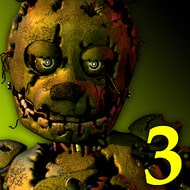
You lift the monitor at 2 AM, spot Springtrap sitting in a dark hallway, and then the ventilation system throws a red error while the audio system stops answering. That is the moment Five Nights at Freddy’s 3 shows what it wants from you: not fast reflexes at a door, but calm handling of three systems that break at the worst possible time. Fazbear’s Fright has no doors and no lights, so every night in this game becomes a question of timing rather than resources.
Springtrap is the only animatronic that can truly end your night, and he crawls through the cameras of Fazbear’s Fright on a route you can bend but never block for good. An audio lure plays a sound in a chosen room, and Springtrap tends to drift toward it, which is why veterans treat the audio system as their steering wheel. The trick is to pick a room on the opposite side of the map from the vent he is approaching, because a lure placed too close only speeds him toward your office.
A safe rhythm for the early hours looks like this:
Lore hunters sometimes get distracted here, staring at every corner of the pizzeria attraction while Springtrap quietly walks toward the vents. Watching his position matters far more than admiring the set dressing, at least until the night ends.
The ventilation system is the quiet villain of the game. When it fails, hallucinations begin to appear, and players call these the Phantoms: Phantom Freddy, Phantom Balloon Boy, Phantom Foxy, and Phantom Mangle all show up in the office or on the cameras to wreck your timing. None of them replaces Springtrap as the real danger, but each one can push you into a mistake while the actual threat is a single camera away.
The maintenance panel is your answer to almost every failure.
A reboot takes several seconds during which that system is offline, so the community habit is to reboot early and never in the middle of a lure. Players who ignore the panel until a Phantom is already staring at them usually lose the night right there.
Early in the game, most newcomers spam audio lures because the sound feels like a safe button. In reality, overusing lures confuses Springtrap’s path and makes him easier to lose track of, and the ventilation warning slips by unnoticed while you are busy. The cleaner habit is to lure once, watch where he goes, and then decide whether a vent seal is needed.
Another common mistake is keeping the monitor up too long. Camera time feels productive, yet your office is exposed the whole time.
There is also an honest debate in the community about fairness. Some players find the Phantom hallucinations cheap, since a jumpscare can hit while you are already handling a system failure, while others argue that this pressure is exactly the point of Fazbear’s Fright. Both sides agree that Night 1 teaches the panel and Night 2 starts punishing sloppy habits.
By the time you reach Night 4, Springtrap moves noticeably faster, and the systems seem to break in clusters instead of one at a time. Managing this means finishing each reboot before starting the next, even when three warnings flash together. Once Night 5 arrives, the margin for error is close to zero, and a single wasted lure can decide the run.
Here is one detail only playing reveals: the muffled clanking when Springtrap slides into a vent is louder than any warning icon. Experienced players turn their headphones up for exactly that sound and react before the camera even confirms it.
Challenge runners then take the Custom Night as the real exam, where Springtrap and the Phantoms can be pushed to extreme settings. Casual players usually stop after the main nights, and that is a perfectly fair way to enjoy the game.
The minigames that appear after a failed night are more than a curiosity. They feed the story of the attraction, and finishing the Save Them sequences is what completes the hidden storyline for players who care about it. Many fans replay early nights simply to find every fragment, and the community is still arguing about how the pieces fit.
The lore is deliberately obscure, and that is a genuine complaint. Some players find the story rewarding, while others feel the minigames are too cryptic to follow without a guide.
Still, the lore side gives Springtrap real weight beyond being a jumpscare source. Knowing his place in the story makes each lure feel less like a button press and more like managing something that refuses to stay dead.
Use the audio lure to pull him toward a room far from the vent he is approaching, then seal the vent when he gets close. Rebooting the audio system between lures keeps that tool ready when you need it most.
They appear when the ventilation system is failing, so the fix is to open the maintenance panel and reboot ventilation. Phantom Freddy and Phantom Balloon Boy are the ones players notice first, but the same reboot handles all of them.
Five nights make up the main run, and extra content such as the Custom Night sits beyond that for players who want harder settings. Each night from 12 AM to 6 AM increases how fast Springtrap moves and how often systems fail.
Five Nights at Freddy’s 3 stays memorable because it turns one slow animatronic into a puzzle about Springtrap’s route, your audio lures, and the ventilation reboot you cannot afford to forget. Once you learn to treat Fazbear’s Fright as a system to maintain rather than a place to hide, the Phantoms lose most of their teeth and each surviving night feels earned.
There are no reviews yet. Be the first one to write one.