 (No Ratings Yet)
 Loading...
Fullscreen



![Hello Kitty [HORROR]](https://printiloveyou.com/wp-content/uploads/2025/03/hello-kitty-horror.jpg "Hello Kitty [HORROR]")





 (No Ratings Yet)Loading...
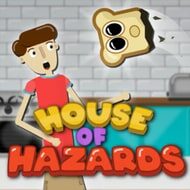
You’re just trying to make coffee. That’s the whole task in House of Hazards — reach the kitchen, interact with the machine, done. Except someone else in the house just flipped the toaster on the second you got close, and now “just making coffee” involves timing a dash past a hazard that wasn’t there a moment ago.
Every round in House of Hazards hands you a set of tasks that sound mundane on paper — reach a location, water the plants, make it out the front door — and turns them into a race against opponents doing the same tasks while actively working against you. The tasks themselves are never the hard part; the traps other players trigger while you’re mid-task are.
Falling objects, swinging items, collapsing floors, and moving contraptions litter every room, and the game’s real hook is that you can activate specific hazards at exactly the moment an opponent walks into range — flipping on the toaster right as someone reaches for their coffee, or setting a swinging toy in motion just as a rival crosses the garden. Reading where an opponent is heading, not just completing your own task, is what separates players who consistently win from ones who only manage their own route.
Picking up another player and dropping them directly into a hazard’s path adds a more aggressive option on top of that, turning House of Hazards into something closer to physical sabotage than a straightforward household obstacle course.
House of Hazards supports one to four players on the same device, so it plays as a genuine local party game rather than something built around remote matchmaking, though testing yourself against AI opponents in single-player mode is also an option when there’s nobody else around to compete against.
After each round, one of the four players gets punished via a spin of a debuff wheel, with outcomes ranging from inverted controls to having heavyweights attached that slow movement down. That punishment carries into the next round, meaning a bad result doesn’t just cost you the round you lost — it actively handicaps your next attempt too.
Random hazard placement, shifting room layouts, and occasional surprise twist mechanics keep House of Hazards from settling into a memorized routine. Even a room you’ve played dozens of times can rearrange its traps enough that old muscle memory stops being reliable.
Rarely for long — since opponents can trigger traps specifically timed to your position, ignoring them usually just means walking into a hazard someone set up on purpose rather than one you failed to notice.
It applies a real handicap, such as inverted movement controls or added weight that slows you down, directly to the next round for whichever player it lands on, making round-to-round consistency harder for whoever’s been losing.
House of Hazards turns ordinary chores into a genuine contest by making the traps a weapon players aim at each other, and it’s that shift from “avoid the hazard” to “trigger it on your rival” that keeps House of Hazards feeling tense even on a task as small as making coffee.
There are no reviews yet. Be the first one to write one.